Aller au contenu
Université de Lille
Laboratoire Laboratoire de Physique des Lasers, Atomes et Molécules | Laboratory of Physics of Lasers, Atoms and Molecules Laboratoire de Physique des Lasers, Atomes et Molécules
UMR 8523
  • Accès & Contact
  • X ( Nouvelle fenêtre)
  • Linkedin ( Nouvelle fenêtre)
    • EN
  • S'identifier
    Mon identité numérique
  • Accès & Contact
  • X ( Nouvelle fenêtre)
  • Linkedin ( Nouvelle fenêtre)
    • EN
  • S'identifier
    Mon identité numérique
  • Laboratoire
    • QUI SOMMES-NOUS ?
    • ORGANISATION
    • ACTUALITÉS
    • AGENDA
    • SÉMINAIRES PhLAM
    • PROJETS ET RÉSEAUX
      • EUROPE & INTERNATIONAL
      • PROJETS NATIONAUX
      • PROJETS LOCAUX & RÉGIONAUX
      • VALORISATION & INDUSTRIE
    • FAITS MARQUANTS
      • PRIX ET DISTINCTIONS
      • SYSTÈMES QUANTIQUES
        • Experimental Observation of a Time-Driven Phase Transition in Quantum Chaos
        • Construction of a telecom-fiber-amplifier based potassium BEC experiment
        • Universal thermodynamics of strongly correlated systems
        • Towards 6G and Topological Valley Photonics for THz coherent communications
      • DYSCO
        • An international reference in topological photonics
        • Ultrafast observation and control of particle accelerators
        • Soliton gases in Optics and in Hydrodynamics (SOGOOD ANR Project)
        • From anatomy of chaos to machine learning-assisted extreme event forecasting
        • New states of light : from quantum to nonlinear regime
        • Data-driven modeling of cell metabolic response to oxidative stress
        • Novel opto-fluidic drug delivery system for efficient cellular transfection
      • PCMT
        • Molecular level description of aerosols: From physical to chemical processes
        • Phys. Rev. Lett. on photodesorption of pure carbon monoxide ice
        • The DIRAC relativistic electronic structure package
        • Protocol for the simulation of electron binding energies
      • PHOTONIQUE
        • All-fiber frequency agile triple-frequency comb light source
        • Fiber-based dosimeter sensor adapted to proton-therapy
        • Ceramic coating for optical fiber
        • Creation of the LabCORE joint laboratory
        • Labeling of the FiberTech Lille platform by the University of Lille
      • PMI
        • Insights into the non-covalent interactions of hydrogen sulfide with fenchol and fenchone from a gas-phase rotational study
        • Smart solution for CO2 capture using gas hydrates with promoters: an alternative for promoting carbon capture and storage
        • At the Crossroads of Science and Society: from the laboratory to European policies
        • Propionamide (C2H5CONH2): The Largest Peptide-like Molecule in Space
        • Insights into the physicochemical environments involved in the Solar System’s formation: characterization of carbonaceous chondrite meteorites by 2-step laser mass spectrometry
    • INTERNATIONAL
  • ÉQUIPES DE RECHERCHE
    • SYSTÈMES QUANTIQUES
      • RECHERCHES
        • I. Condensat de Bose-Einstein
        • II. Théorie des champs
        • III. Information quantique
        • IV. Communication THz
        • V. Culture scientifique
      • MEMBRES
      • PROJETS ET CONTRATS
      • COLLABORATIONS
      • PUBLICATIONS ET CONFÉRENCES
    • DYSCO
      • RECHERCHES
        • I. Out of Equilibrium Systems
        • II. Nonlinear Dynamics and Quantum Optics
        • III. Dynamics of Accelerators
        • IV. Biophysics
      • MEMBRES
      • PROJETS ET CONTRATS
      • Équipements
      • Collaborations
      • Publications et conférences
    • PCMT
      • RECHERCHES
        • I. Méthodologies de modélisation des réactions d'interface gaz/particules et des propriétés globales
        • II. Comprendre les processus moléculaires dans le milieu interstellaire
        • III. Formation, composition et réactivité des particules d'aérosol et leurs implications pour l'atmosphère terrestre
        • IV. Modélisation des propriétés physiques et chimiques des éléments lourds et des radionucléides dans le contexte du cycle du combustible nucléaire
      • MEMBRES
      • PROJETS ET CONTRATS
      • ÉQUIPEMENTS
      • COLLABORATIONS
      • PUBLICATIONS ET CONFÉRENCES
    • PHOTONIQUE
      • RECHERCHES
        • I. Imagerie micro-endoscopique
        • II. Nouvelles sources de lumière
        • III. Dynamique non-linéaire dans les fibres complexes
        • IV. Photonique multimodale et lumière structurée
        • V. Synthèse additive sur fibre
        • VI. Capteurs pour environnements sévères et dosimétrie
      • MEMBRES
      • PROJETS ET CONTRATS
      • ÉQUIPEMENTS
      • COLLABORATIONS
      • PUBLICATIONS ET CONFÉRENCES
    • PMI
      • RECHERCHES
        • Spectroscopie rovibrationnelle (SPECTRO)
        • Analyses de traces (ANATRAC)
      • MEMBRES
      • PROJETS ET CONTRATS
      • ÉQUIPEMENTS
      • COLLABORATIONS
      • PUBLICATIONS ET CONFÉRENCES
  • SERVICES COMMUNS & MISSIONS TRANSVERSES
    • SERVICE FINANCIER
    • SERVICE RH & INFRASTRUCTURE
    • SERVICE COMMUNICATION
    • SERVICE ÉLECTRONIQUE & INFORMATIQUE
    • SERVICE OPTIQUE & INSTRUMENTATION
    • SERVICE MÉCANIQUE
    • PRÉVENTION
    • PARITÉ - ÉGALITÉ
    • PhLAM DURABLE
  • PLATEFORMES & PLATEAUX TECHNIQUES
    • CERLA
    • FIBERTECH LILLE
    • BIOPHOTONIQUE
    • SAKURA
  • PRODUCTION SCIENTIFIQUE
    • HIGHLIGHTS
    • CONFÉRENCES ET SÉMINAIRES
    • OUVRAGES
    • PUBLICATIONS
  • MÉDIATION ET VALORISATION
    • MÉDIATION SCIENTIFIQUE
    • INNOVATION & VALORISATION
  • EMPLOIS & STAGES
    • OFFRES EN COURS
    • STAGES DE MASTER
    • STAGES DE DÉCOUVERTE
  • FORMATION DOCTORALE
    • FORMATION PAR LA RECHERCHE
    • OFFRES DE THÈSES
    • THÈSES EN COURS
    • THÈSES SOUTENUES
    • VIE ASSOCIATIVE ÉTUDIANTE
    • ACTUALITÉS DES DOCTORANTS
    • DOCUMENTS UTILES
  1. PhLAM
  2. >
  3. ÉQUIPES DE RECHERCHE
  4. >
  5. DYSCO
  6. >
  7. RECHERCHES
  8. >
  9. II. Nonlinear Dynamics and Quantum Optics
  10. >
  11. Nonlinear Dynamics of Optical Systems
ÉQUIPES DE RECHERCHE DYSCO
  • RECHERCHES
    • I. Out of Equilibrium Systems
    • II. Nonlinear Dynamics and Quantum Optics
    • III. Dynamics of Accelerators
    • IV. Biophysics
  • MEMBRES
  • PROJETS ET CONTRATS
  • Équipements
  • Collaborations
  • Publications et conférences

Nonlinear Dynamics of Optical Systems

Spatial and/or temporal localization of information is a cross-disciplinary challenging topic. In the recent years it has become very attractive subject of research with the connection of extreme events. So called events are rare and large deviation of the average behavior of an observable. Example include power grid outage, earthquakes, floods, financial cracks or oceanic rogue waves. In the context of global climate changing, these events are expected to become more frequent and more damaging according to the Intergovernmental Panel on Climate Change (IPCC). Decision makers will need accurate forecasting for the reduction of human and societal cost. Hence, after years of trying to understand mechanisms behind extreme events the challenge has moved on their forecasting or inference. Here again, by their demonstrated analogy with a large variety of physical systems, optics is a precious asset. Turbulence dominates the physical behavior of a huge variety of scenarios and lies at the basis of our understanding of systems ranging from small scales such as optical waves in photonic fluids and matter waves in Bose-Einstein condensates, to intermediate scales such as ocean water waves, or even on cosmic scales through the formation of coherent structures in the Universe. 

Optical turbulence also constitutes a growing field of research covering various topics in modern optics, e.g., supercontinuum generation, rogue waves, fiber lasers, optical filamentation, and random lasers. Nonlinear optics offers a unique platform to study fully developed turbulence, which remains one of the most challenging unsolved problems, not only of theoretical physics but also in the field of experimental real-time ultrafast measurements, which are needed to fully quantify turbulent spatiotemporal evolution. Over the 2013-2018 period, the team focused primarily on two issues related to the study of extreme events: (i) the study of turbulence and its ramifications as spatiotemporal chaos and extreme events appearing in the strongly nonlinear regime of optical systems far from equilibrium and (ii) the predictability of extreme events. 

The study of turbulence started in the wake of the ANR OptiRoC yield to the development of tools that were used in a fiber ring cavity to unveil the second order-like phase transition (Phys. Rev. X 9, 011054 (2019)). In the scope of the prediction of extreme events the group has provided a proof of concept that tools of dynamical systems theory, information theory and machine learning can be gathered together to forecast when, where and the profile of extreme events in fiber ring cavity and semi-conductor laser (Phys. Rev. Lett. 130, 223801 (2023), Chaos, Solitons & Fractals 160, 112199 (2023)). Our recent work has shown how machine learning can be powerful when combined with the tools of dynamical system theory. On the other hand, there is another kind of localization in time with growing interest: the time crystals. These crystals were theoretically introduced in 2012 by Frank Wilczek. Similar to "classic" crystals in condensed matter, the goal here is to create a temporal signal with discrete translation symmetry. In many systems the dynamics beyond these crystals are still relatively unknown and poorly studied at this stage.

The group also strengthens its skills in the discovery of new mechanisms of localization of light. Indeed, the study of the localization of light in a small region of the available domain is one of the historical research topics of the group. The interest around e.g. the frequency combs and optical dam break topics are proofs that localization of light remains a prior topic in Nonlinear Dynamics. Achievement in this topic include localization induced by nonlocal and stochastic medium [Phys. Rev. E 103, 022701 (2021)], time delayed response [Phys. Rev. Research 2, 013024] and high dimensionality [Phys. Rev. Lett. 126, 153902 (2021)].

More detailed information can be found below about the activities on the Influence of spatial nonlocality and stochasticity on the propagation of light structures:
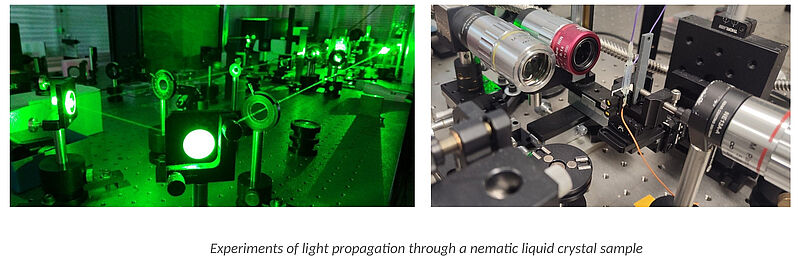
  • Nonlinear dynamics in nonlocal and stochastic optical systems: the example of liquid crystals


Laboratoire de Physique des Lasers, Atomes et Molécules | Laboratory of Physics of Lasers, Atoms and Molecules
Laboratoire de Physique des Lasers, Atomes et Molécules
  • X ( Nouvelle fenêtre)
  • Linkedin ( Nouvelle fenêtre)
  • Accessibilité : non conforme
  • Mentions légales | Accès & Contact
  • Plan du site
Université de Lille ©  2026
Page mise à jour le 26/08/2024 (16:12)
Université de Lille
CNRS