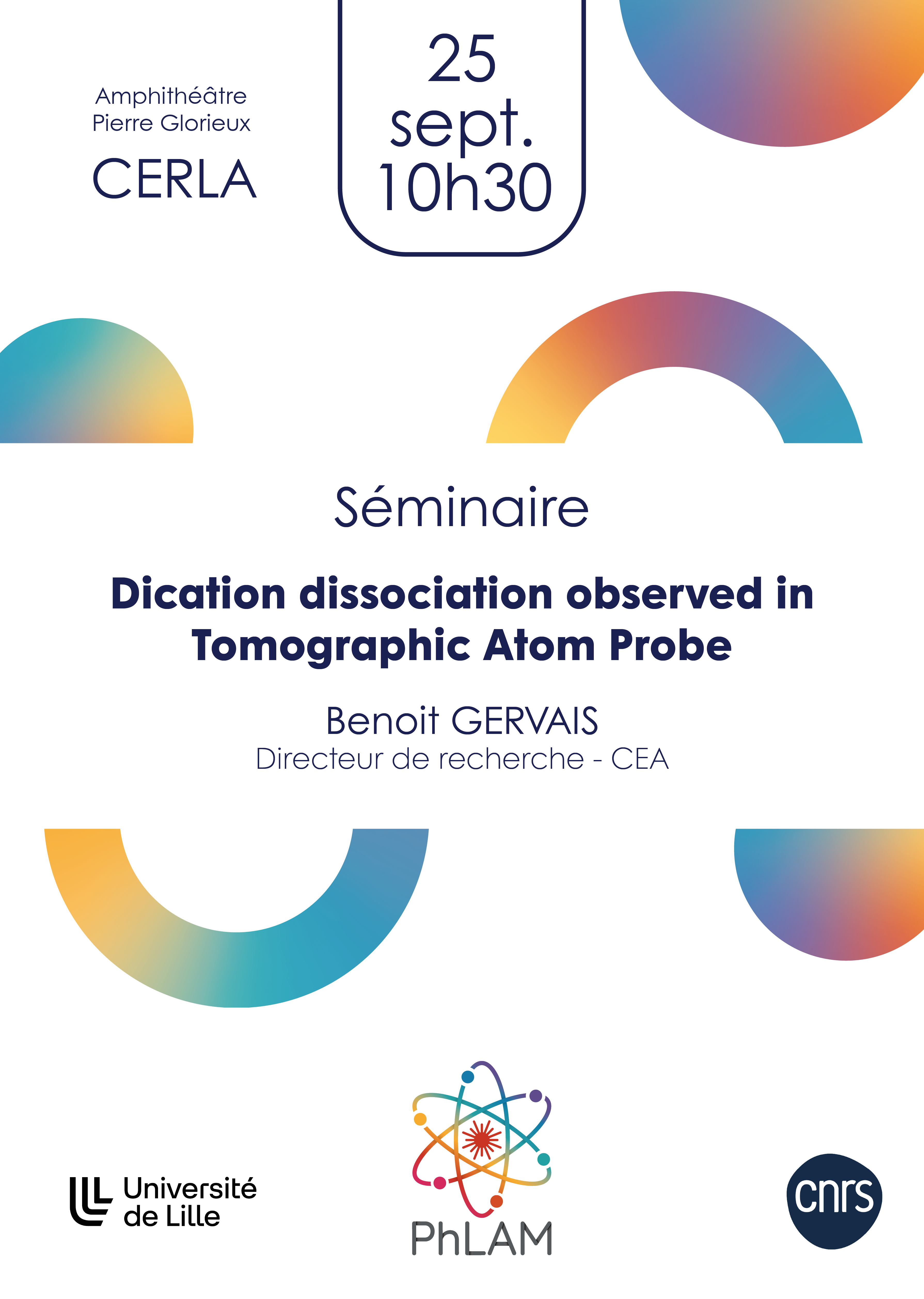
Séminaire du PhLAM par Benoit GERVAIS
phlam Séminaire Vie du laboLe séminaire sera animé par Benoit Gervais, Directeur de recherche au CEA, et aura pour thème "Dication dissociation observed in Tomographic Atom Probe".
Résumé :
The emission of single atomic ions in Tomographic Atom Probe (TAP) experiments is based on the principle of ion field emission from polarized sharp tip, where the electric field at the apex can reach values as high as eV/nm. It is often associated to correlated emission leading to multiple events, which can be observed experimentally in a correlated event map, where the charge-over-mass ratio of the second fragment is plotted versus the charge-over-mass ratio of the first fragment. In such a map, some specific features appear as correlation tracks, which have been explained as a result of the in-flight dissociation of a parent molecular ion into charged fragments [1]. Though the process is clearly identified, the origin of the in-flight dissociation of molecular dications has only been recently investigated from a theoretical point of view [2, 3].
I will present a theoretical analysis of the fragmentation of doubly charged diatomic commonly observed in TAP experiments: ZnO2+, SiO2+, AlN2+, GaN2+ emitted from corresponding metal-oxide or metal-nitride alloys and also C22+ emitted from cemented tungsten carbide targets. Our analysis is based on the simulation of the ion dynamics in the field of a paraboloid tip for a model internal energy of the molecule deduced from accurate ab initio calculation of the electronic structure. We show that the spin-orbit coupling between electronic states of different spin symmetries is at the origin of the in-flight dissociation. We shall see however, that the specificity of each molecular dication, and in particular its electronic structure, is essential to analyze the experimental observations, because it conditions the dissociation dynamics and the nature of the dissociating products. Regarding the physical concepts for TAP operation, this dissociation process is a clear indication that excited states are formed during ion emission from the surface.
Le résumé est à retrouevr ici.