Go to content
Université de Lille
Laboratoire Laboratoire de Physique des Lasers, Atomes et Molécules | Laboratory of Physics of Lasers, Atoms and Molecules Laboratory of Physics of Lasers, Atoms and Molecules
UMR 8523
  • Access & contact
  • X ( New window)
  • Linkedin ( New window)
    • FR
  • S'identifier
    Mon identité numérique
  • Access & contact
  • X ( New window)
  • Linkedin ( New window)
    • FR
  • S'identifier
    Mon identité numérique
  • Laboratory
    • Who are we?
    • Organization chart
    • News
    • AGENDA
    • SEMINARS
    • Projects and contracts
    • Highlights
  • Research Teams
    • Quantum systems
      • Research
        • I. Bose-Einsten condensate
        • II. Quantum field theory
        • III. Quantum information
        • IV. THz Communication
        • V. Outreach
      • Members
      • Projects and Contracts
      • Collaborations
      • Publications and conferences
    • DYSCO
      • Research
        • I. Out of Equilibrium Systems
        • II. Nonlinear Dynamics and Quantum Optics
        • III. Dynamics of Accelerators
        • IV. Biophysics
      • Members
      • Projects and contracts
      • Equipment
      • Collaborations
      • Publications and conferences
    • PCMT
      • Research
        • I. Methodologies to model gas/particle interface reactions and bulk properties
        • II. Unraveling Molecular Processes in the Interstellar Medium
        • III. Formation, composition and reactivity of aerosol particles and their implications for the Earth atmosphere
        • IV. Modelling of heavy elements and radionuclides physical and chemical properties in the context of the nuclear fuel cycle
      • MEMBERS
      • Projects and contracts
      • Equipment
      • Collaborations
      • Publications and Conferences
    • Photonics
      • Research
        • I. Active fibers
        • II. Advanced fiber modeling
        • III. Non-linear photonics in fibers
      • Members
      • Projects and contracts
      • Equipment
      • Publications and conferences
    • MPI
      • Research
        • Rovibrational spectroscopy (SPECTRO)
        • Traces analyses (ANATRAC)
      • Members
      • Projects and contracts
      • Equipment
      • Collaborations
      • Publications and conferences
  • Poles & Missions
  • Platform & Technical Platform
    • CERLA
    • FiberTech Lille
    • Sakura
  • Recruitment
    • Job
    • Internship
  • PhD Area
    • Summaries of the thesis
  1. PhLAM
  2. >
  3. Research Teams
  4. >
  5. Photonics
  6. >
  7. Research
  8. >
  9. II. Advanced fiber modeling
  10. >
  11. 1) Multimode fiber amplifiers
Research Teams Photonics
  • Research
    • I. Active fibers
    • II. Advanced fiber modeling
    • III. Non-linear photonics in fibers
  • Members
  • Projects and contracts
  • Equipment
  • Publications and conferences

1) Multimode fiber amplifiers

Page en attente de traduction / Page awaiting translation

L’augmentation sans cesse croissante des débits de communication conduit à trouver des solutions de rupture. En effet, à l’horizon 2020, les limites des réseaux actuels basés sur des fibres monomodes devraient attendre leur limite. Le multiplexage spatiale (fibres multimodes ou multi-cœurs) s’avère être une solution envisagée pour les réseaux du futur et suscite un intérêt certain dans la communauté scientifique.

Les fibres optiques, mais aussi les fibres amplificatrices et les composants optiques adaptés (MUX/DEMUX, etc) doivent être adaptés et repensés. Dans ce cadre, l’équipe travaille de façon active sur la conception de nouveaux amplificateurs à fibre légèrement multimodes [1]. Le challenge réside dans la conception de fibres permettant l’amplification simultanée et similaire des signaux portés par les différents modes de la fibre (typiquement LP01, LP11, LP21, LP02) utilisés pour le transport de l’information.

Le groupe a donc développé des outils de modélisation d’amplificateurs multimodes adaptés à cette thématique, et a été le premier a démontré au niveau international la réalisation d’un amplificateur supportant 6 modes.
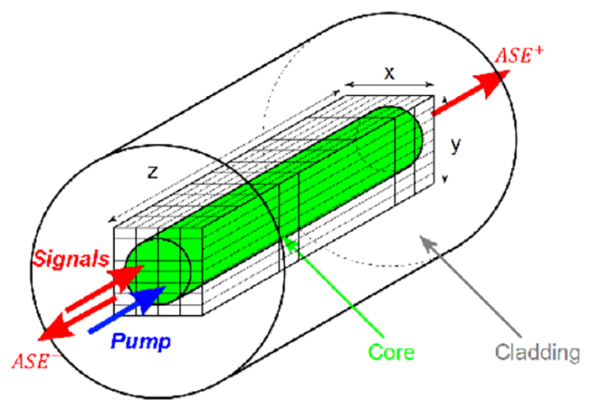
Maillage utilisé pour le modèle théorique d’amplification multimode. En vert : répartition en ions actifs.

2) Guiding mechanisms

To top

Laboratoire de Physique des Lasers, Atomes et Molécules | Laboratory of Physics of Lasers, Atoms and Molecules
Laboratory of Physics of Lasers, Atoms and Molecules
  • X ( New window)
  • Linkedin ( New window)
  • Accessibility : non-compliant
  • Legal notice | Access & contact
  • Sitemap
Université de Lille ©  2026
Page updated on 08-28-2024 (12:23)
Université de Lille
CNRS