

LOCAL & REGIONAL PROJECTS
Team: PCMT - MPI
PhLAM Project Manager: Cristian FOCSA
Partners: CERI EE, ICARE/AERIS, LASIRE, LOA, LPCA, PC2A, PhLAM
Abstract: The AREA project aims to strengthen the University of Lille’s role as a unifying and driving force in the field of atmospheric sciences in the Hauts-de-France region, building on the legacy of the CaPPA Labex. What sets it apart at the national and European levels is its approach to atmospheric aerosol science, which combines molecular modeling, laboratory studies, and fieldwork—ranging from the most fundamental processes to local and global observations, including atmospheric modeling. Equipped with state-of-the-art equipment and innovative methodologies, the AREA project aims to improve the measurement of complex interactions between aerosols and the environment at different scales. The ultimate goal is to deepen our understanding of aerosol behavior in the atmosphere and improve simulation capabilities. Research focuses on gaining knowledge about natural and anthropogenic sources of aerosols (variability and long-term trends in the context of global climate change), their transport and fate in the atmosphere, as well as their optical and hygroscopic properties. In addition, the project aims to assess the impact of aerosols on weather, climate, and air quality.

Team: MPI - PCMT
PhLAM Project Manager: Claire PIRIM
Partners: 14 I-site partners, 8 A2U partners, 7 other partners
Abstract: The ECRIN project aims to better understand the effects of human-induced climate and environmental changes on health and biodiversity, in order to propose adaptation and mitigation measures. It builds on the achievements of the CLIMIBIO and IRenE projects (CPER 2015–2020) to form a national and European consortium of laboratories engaged in multidisciplinary environmental research that combines advanced research with practical applications in the economic sector.
ECRIN covers a broad disciplinary spectrum, from physical chemistry to urban planning, in order to:
- Characterize the physical and chemical properties of urban, suburban, and rural environments using experimental and theoretical approaches;
- Assess their impacts on human health and ecosystem services;
- Propose appropriate mitigation and adaptation measures (behavioral changes, transportation, land-use planning);
- Promote the transfer of innovations to the private sector.
Team: Quantum Systems
PhLAM Project Manager: Alexandre FELLER
Partners:
Abstract: My research project focuses on the quantum-to-classical transition, a fundamental problem aimed at understanding how the quantum properties of a system disappear to give way to classical behavior. This transition is governed by decoherence, a phenomenon resulting from the entanglement between a system and its environment, and represents a major obstacle for quantum technologies. Despite recent advances, notably with the quantum Darwinism proposed by Zurek, the physical understanding of the role of observers and the reconstruction of a shared classical picture remains incomplete.
The project proposes to address this question from an interdisciplinary perspective, at the intersection of quantum physics, mathematics, and quantum computing. The goal is to develop a general framework for the physics of observers, based on resource theory, in order to analyze how a classical description can emerge from a quantum system and be shared among multiple observers.
A key part of the project is devoted to studying entanglement between indistinguishable particles. In particular, the project aims to examine entanglement between electrons within the framework of quantum electronic optics, a rapidly developing field that allows for the manipulation of individual electrons in a manner analogous to photons in quantum optics.
Team: Photonics
PhLAM Project Manager: Géraud BOUWMANS
Partners:
Abstract: DOMMiNO aims to develop innovative Mamyshev fiber laser oscillators that would overcome the technological barriers associated with this type of femtosecond source. We will seek to understand the underlying principles of this type of oscillator and identify the physical phenomena that govern it. The project is based on numerical studies using tools developed in-house. This understanding will guide the experimental work to achieve the objectives regarding energy, duration, and temporal compression quality. We will also investigate certain internal dynamics of these oscillators that remain poorly understood to date. We will then demonstrate the use of these sources for multimodal nonlinear micro-endoscopy (2PEF and SHG). To our knowledge, the use of a single oscillator has not yet been demonstrated for multiphoton microscopy applications, and even less so in the context of micro-endoscopy. Finally, we will work to extend the emission spectral range beyond 1200 nm to make the source compatible with micro-endoscopy using non-degenerate two-photon fluorescence excitation and multi-wavelength 2PEF. We will attempt to demonstrate a proof of concept for these types of endoscopic imaging, which, to our knowledge, is a first, regardless of the source and wavelengths used.
Team: Quantum Systems
PhLAM Project Manager: Pascal SZRIFTGISER
Partners: PhLAM, IEMN, IRCICA, LPP, LPCA, UCCS
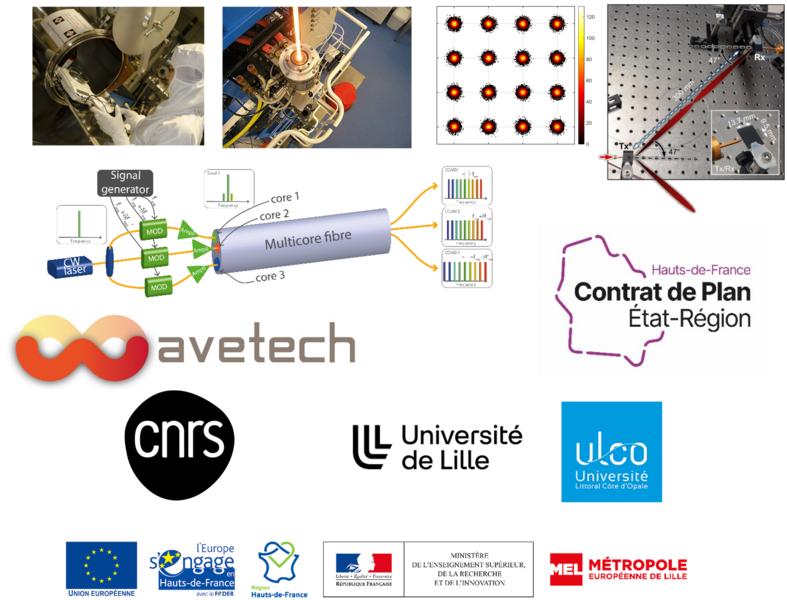
Abstract: The WaveTech@HdF consortium includes the following partner laboratories: PhLAM (UMR8523), IEMN (UMR8520), IRCICA (USR3380), LPP (UMR8524), UCCS (UMR8181), and LPCA (ULCO). With a commitment to research excellence, the WaveTech CPER will strengthen the consortium’s capacity for technological development and commercialization. Adopting a project-based approach, WaveTech@HdF aims to strengthen major local research infrastructures, particularly through its pilot lines. This involves focusing resources on acquiring equipment—some of which is unique in Europe—in close collaboration with PhLAM’s Fibertech Lille facility and IEMN’s CMNF (Micro and Nano Fabrication Center). It is worth noting that the presence of an optical fiber facility and a micro- and nanoelectronics facility on the same site is likely unique in the world. Developing synergies between these complementary technologies has the potential for very high added value, with significant benefits for partner units and industrial collaborators.
In close collaboration with the CDP C2EMPI and the App4P Equipex, and in line with the themes of the University of Lille’s Initiative of Excellence, WaveTech@HdF plans to conduct research on the broad topics of photonics, terahertz (THz) waves, and quantum mechanics, which governs the fundamental laws of nature. Particular attention will be given to the rapidly evolving field of topology-based research (2016 Nobel Prize in Physics). The topics covered range from materials with new properties and functionalities—essential for ultra-high-speed data transmission—to a study of the life cycle of certain materials used in industry or consumer products, with innovative solutions for their recycling.
Team: DYSCO
PhLAM Project Manager: Emmanuel COURTADE
Partners: PHLAM, IEMN, GRITA, CANTHER … + about thirty other regional organizations
Abstract: The TECSANTÉ project—Technologies for Acute and Chronic Precision Health—aims to establish a regional platform for technological innovation dedicated to personalized and precision health. Led by I-SITE Université Lille Nord-Europe, it brings together academic, hospital, and industrial stakeholders in the Hauts-de-France region around a continuum of Research – Innovation – Training. Organized around the three pillars of Design – Evaluation – Modeling, TECSANTÉ supports the development of medical devices, advanced therapy medicinal products, and e-health solutions incorporating artificial intelligence and biomimetic modeling. This multi-site project combines expertise in micro/nanotechnologies, bioconstruction, bioprinting, and digital health to design the therapeutic and diagnostic tools of the future. By strengthening regional platforms (IEMN, Evalab, CMNF, CIC-IT, etc.), TECSANTÉ aims to position the Hauts-de-France region as a hub for innovation in health technologies, promoting industrial transfer, startup creation, and training.
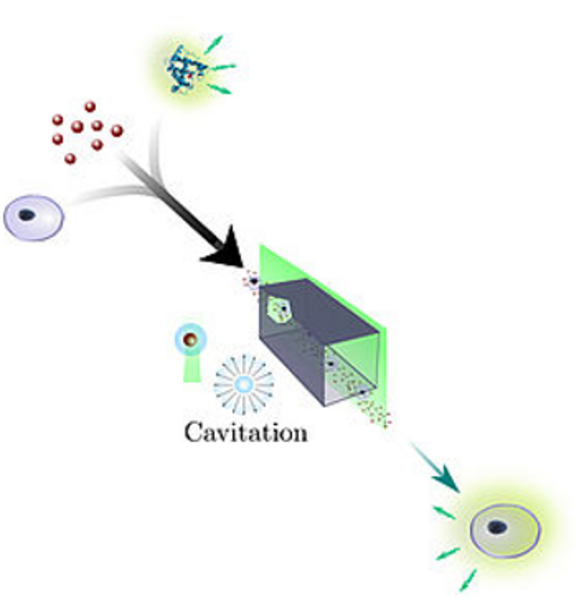
As part of the CPER TECSANTÉ initiative, the project led by PhLAM aims to design an innovative opto-fluidic microfluidic device that combines contactless photoporation and thermo-activated cell sorting to enable non-viral, rapid and safe non-viral transfection of immune cells (T and NK cells) for gene and cell therapies, drawing on the complementary expertise of PhLAM (optofluidics), IEMN (microfabrication), CANTHER (immunotherapy), and GRITA (hospital pharmacy).
Team: MPI
PhLAM Project Manager: Elodie GLOESENER
Partners: Jet Propulsion Laboratory, Laboratoire de Planétologie et Géosciences
Abstract:
This project aims to study the formation kinetics and stability of mixed hydrates (CO2-N2, CO2-CH4) in saline environments, with a focus on their potential for effective CO2 sequestration. Raman spectroscopy is used to monitor hydrate formation and CO2 trapping as a function of temperature, pressure, and CO2 solubility. The role of dissolved salts (e.g., NaCl, CaCl2) is examined to understand their impact on hydrate stability and molecular selectivity. The effects of porous materials, mimicking marine sediments, are also studied to assess how composition and porosity influence the efficiency of CO₂ trapping within hydrates.
The new data and analyses obtained in this way could contribute to the development of CO2 storage technologies in saline environments that are both more efficient and more reliable, thereby supporting climate change mitigation efforts. They will also benefit geophysical models of icy moons by providing new constraints on the composition of hydrates formed in subsurface oceans.
Teams: MPI - Quantum Systems - CERLA
PhLAM Project Manager: Stéphane BAILLEUX
Partners: Daniel HENNEQUIN, Philippe VERKERK, Radu CHICIREANU, Bénédicte CALLIMET
Abstract: This project is part of an initiative to promote scientific literacy and foster an appreciation for physics among young audiences. It aims to spark curiosity and interest in science among middle and high school students. The goal is to introduce them to the fascinating world of physics, stimulating their curiosity, critical thinking, and passion for scientific discovery.
A dedicated space will host interactive and educational experiments illustrating fundamental concepts of physics through devices that are both entertaining and spectacular, such as trichromatic holography and single-photon light interference. These experiments will provide an ideal setting for engaging with scientific staff, inspiring future careers, and strengthening the ties between education, research, and society.