Go to content
Université de Lille
Laboratoire Laboratoire de Physique des Lasers, Atomes et Molécules | Laboratory of Physics of Lasers, Atoms and Molecules Laboratory of Physics of Lasers, Atoms and Molecules
UMR 8523
  • Access & contact
  • X ( New window)
  • Linkedin ( New window)
    • FR
  • S'identifier
    Mon identité numérique
  • Access & contact
  • X ( New window)
  • Linkedin ( New window)
    • FR
  • S'identifier
    Mon identité numérique
  • Laboratory
    • WHO ARE WE?
    • ORGANIZATION
    • NEWS
    • AGENDA
    • PhLAM SEMINARS
    • PROJECTS AND NETWORKS
      • EUROPE & INTERNATIONAL
      • NATIONAL PROJECTS
      • LOCAL & REGIONAL PROJECTS
      • VALORIZATION & INDUSTRY
    • HIGHLIGHTS
      • AWARDS AND DISTINCTIONS
      • QUANTUM SYSTEMS
        • Experimental Observation of a Time-Driven Phase Transition in Quantum Chaos
        • Construction of a telecom-fiber-amplifier based potassium BEC experiment
        • Universal thermodynamics of strongly correlated systems
        • Towards 6G and Topological Valley Photonics for THz coherent communications
      • DYSCO
        • An international reference in topological photonics
        • Ultrafast observation and control of particle accelerators
        • Soliton gases in Optics and in Hydrodynamics (SOGOOD ANR Project)
        • From anatomy of chaos to machine learning-assisted extreme event forecasting
        • New states of light : from quantum to nonlinear regime
        • Data-driven modeling of cell metabolic response to oxidative stress
        • Novel opto-fluidic drug delivery system for efficient cellular transfection
      • PCMT
        • Molecular level description of aerosols: From physical to chemical processes
        • Phys. Rev. Lett. on photodesorption of pure carbon monoxide ice
        • The DIRAC relativistic electronic structure package
        • Protocol for the simulation of electron binding energies
      • PHOTONICS
        • All-fiber frequency agile triple-frequency comb light source
        • Fiber-based dosimeter sensor adapted to proton-therapy
        • Ceramic coating for optical fiber
        • Creation of the LabCORE joint laboratory
        • Labeling of the FiberTech Lille platform by the University of Lille
      • MPI
        • Insights into the non-covalent interactions of hydrogen sulfide with fenchol and fenchone from a gas-phase rotational study
        • Smart solution for CO2 capture using gas hydrates with promoters: an alternative for promoting carbon capture and storage
        • At the Crossroads of Science and Society: from the laboratory to European policies
        • Propionamide (C2H5CONH2): The Largest Peptide-like Molecule in Space
        • Insights into the physicochemical environments involved in the Solar System’s formation: characterization of carbonaceous chondrite meteorites by 2-step laser mass spectrometry
    • INTERNATIONAL
  • Research Teams
    • QUANTUM SYSTEMS
      • Research
        • I. Bose-Einsten condensate
        • II. Quantum field theory
        • III. Quantum information
        • IV. THz Communication
        • V. Outreach
      • Members
      • Projects and Contracts
      • Collaborations
      • Publications and conferences
    • DYSCO
      • Research
        • I. Out of Equilibrium Systems
        • II. Nonlinear Dynamics and Quantum Optics
        • III. Dynamics of Accelerators
        • IV. Biophysics
      • Members
      • Projects and contracts
      • Equipment
      • Collaborations
      • Publications and conferences
    • PCMT
      • Research
        • I. Methodologies to model gas/particle interface reactions and bulk properties
        • II. Unraveling Molecular Processes in the Interstellar Medium
        • III. Formation, composition and reactivity of aerosol particles and their implications for the Earth atmosphere
        • IV. Modelling of heavy elements and radionuclides physical and chemical properties in the context of the nuclear fuel cycle
      • Members
      • Projects and contracts
      • Equipment
      • Collaborations
      • Publications and Conferences
    • PHOTONICS
      • Research
        • I. Active fibers
        • II. Advanced fiber modeling
        • III. Non-linear photonics in fibers
      • Members
      • Projects and contracts
      • Equipment
      • Publications and conferences
    • MPI
      • Research
        • Rovibrational spectroscopy (SPECTRO)
        • Traces analyses (ANATRAC)
      • Members
      • Projects and contracts
      • Equipment
      • Collaborations
      • Publications and conferences
  • Shared services & cross-functional missions
    • FINANCIAL SERVICES
    • HR & INFRASTRUCTURE DEPARTMENT
    • COMMUNICATIONS DEPARTMENT
    • ELECTRONIC & IT SERVICES
    • OPTICAL & INSTRUMENTATION SERVICE
    • MECHANICAL SERVICE
    • PREVENTION
    • PARITY - EQUALITY
    • SUSTAINABLE PhLAM
  • Platform & Technical Platform
    • CERLA
    • FIBERTECH LILLE
    • BIOPHOTONICS
    • SAKURA
  • Scientific output
    • HIGHLIGHTS
    • CONFERENCES AND SEMINARS
    • WORKS
    • PUBLICATIONS
  • Public Engagement and Technology Transfer
    • SCIENTIFIC MEDIATION
    • INNOVATION & VALORIZATION
  • Jobs & internships
    • CURRENT OFFERS
    • MASTER'S INTERNSHIPS
    • WORK EXPERIENCE PLACEMENT
  • Doctoral training
    • RESEARCH-BASED TRAINING
    • THESIS OFFERS
    • THESES IN PROGRESS
    • THESES DEFENDED
    • STUDENT LIFE
    • DOCTORAL STUDENT NEWS
    • USEFUL DOCUMENTS
  1. PhLAM
  2. >
  3. Research Teams
  4. >
  5. PHOTONICS
  6. >
  7. Research
  8. >
  9. III. Non-linear photonics in fibers
  10. >
  11. 1) Hydrodynamic / optical analogy
Research Teams PHOTONICS
  • Research
    • I. Active fibers
    • II. Advanced fiber modeling
    • III. Non-linear photonics in fibers
  • Members
  • Projects and contracts
  • Equipment
  • Publications and conferences

1) Hydrodynamic / optical analogy

Page en attente de traduction / Page awaiting translation

Cette thématique a été initiée en 2008 au sein du groupe, alors qu’une course effrénée était lancée au niveau international concernant la montée en puissance des sources supercontinuum blanches à fibre optique. Elles étaient en effet limitées à une puissance moyenne totale de 4 W à cette époque. L’originalité de nos travaux a porté sur l’utilisation de lasers à fibre continus, dont la puissance moyenne dépasse fortement celle des sources impulsionnelles habituellement utilisées. Nous avons alors cherché à compenser la faible puissance « crête »de ces sourcescontinues (de l’ordre de quelques dizaines de watts) par une augmentation dela longueur des fibres dans lesquelles se produisent les effets non-linéaires, et surtout par une optimisation minutieuse de leurs propriétés. Ainsi, en utilisant des fibres microstructurées effilées sur typiquement 100 m et en optimisant le dopage germanium du cœur, nous avons démontré la première source blanche continue, dont la puissance moyenne de 10 W constituait un record en 2010 [1]. Ces travaux ont suscité un vif intérêt de la communauté puisqu’ils ont été mis à l’honneur dans différentes revues industrielles (PhotonicsSpectra, Photoniques) et de diffusion scientifique (Science & Avenir, journal du CNRS). 

Par ailleurs, nous nous sommes intéressés aux caractéristiques temporelles de ces sources, primordiales pour certaines applications et qui s’inscrivent dans le cadre général et plus fondamental de celui des ondes scélérates optiques. Nous avons montré qu’elles résultent de la collision de solitons [2] et que l’ingrédient minimum et nécessaire pour leur apparition est la dispersion d’ordre trois  [3]. Ces études fondamentales nous ont permis de mettre au point une solution passive pour stabiliser temporellement les sources supercontinuum  [4]. Nous avons bénéficié auprès d’OSEO et du CNRS du financement d’un ingénieur (1 an) pour développer un prototype qui présente des instabilités bien plus faibles que les modèles commerciaux (3 à 4 fois plus stable).
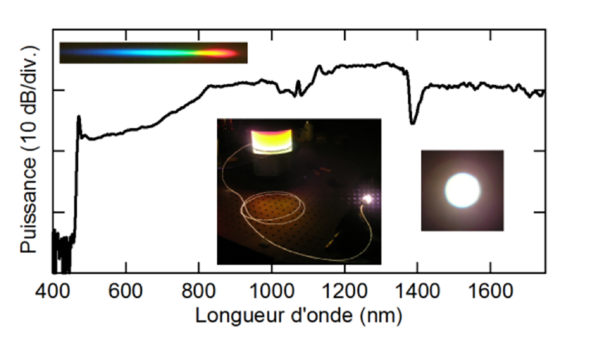
Spectre de la source supercontinuum blanche et continue et photos de l’expérience.

2) Parametric processes

3) Solitons

To top

Laboratoire de Physique des Lasers, Atomes et Molécules | Laboratory of Physics of Lasers, Atoms and Molecules
Laboratory of Physics of Lasers, Atoms and Molecules
  • X ( New window)
  • Linkedin ( New window)
  • Accessibility : non-compliant
  • Legal notice | Access & contact
  • Sitemap
Université de Lille ©  2026
Page updated on 02-17-2026 (11:49)
Université de Lille
CNRS