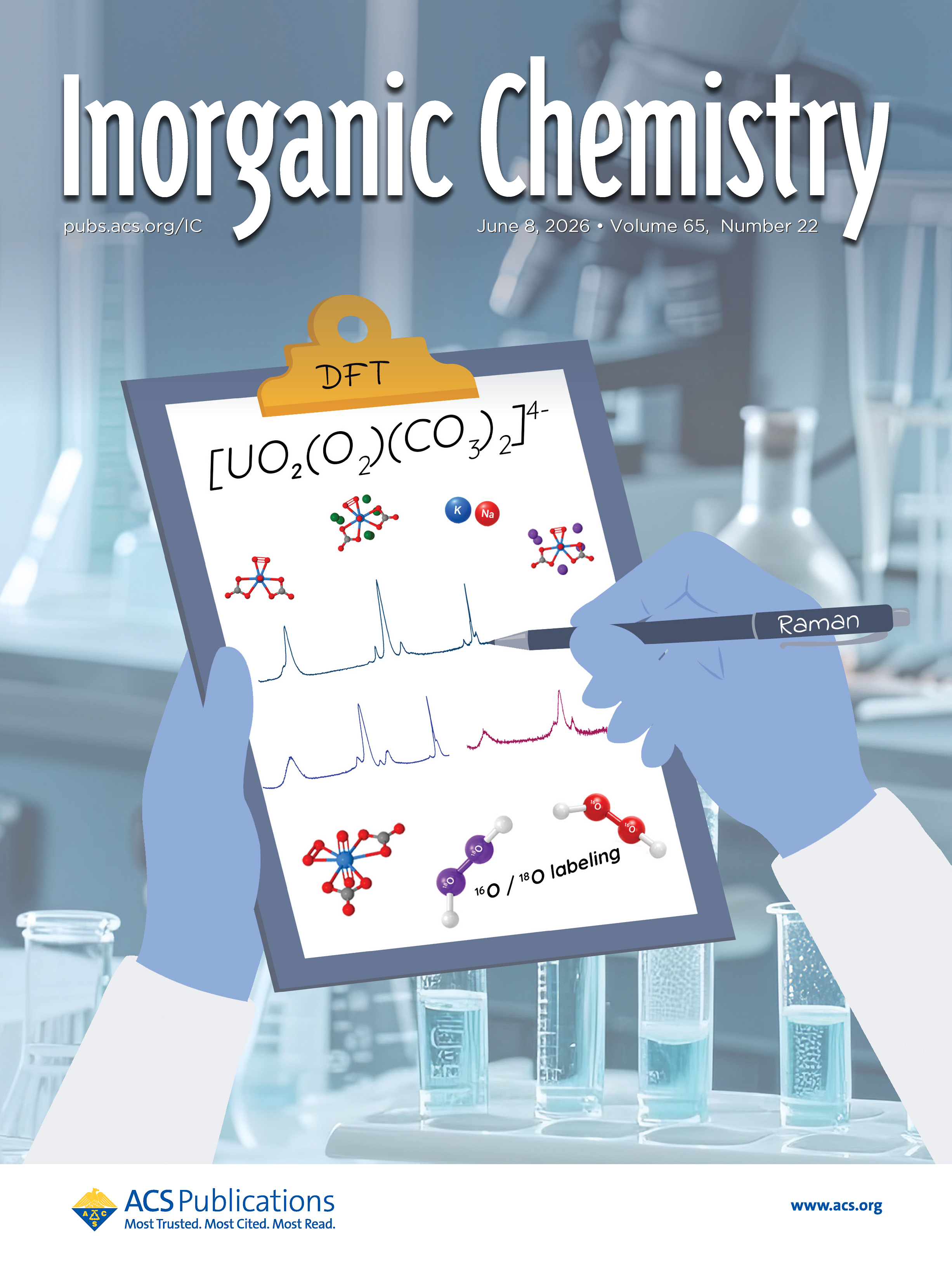
The PCMT team has published a paper in *Inorganic Chemistry* and features on the journal’s cover
PCMT Vie du labo Parutions
Julien Margate, the study’s lead author, along with Valérie Vallet and Florent Réal, researchers at the PhLAM laboratory and members of the PCMT team, are among the authors of this new publication, which has been featured in the journal *Inorganic Chemistry*, with a selection appearing on the cover. This work was carried out in collaboration with the UCCS laboratory (CNRS, University of Lille, University of Artois, Centrale Lille), with the participation of Murielle Rivenet, Elise Berrier and Leonard Florea, as well as Gaëlle Milanole from Orano.
In this article entitled "Synthesis and Vibrational Identification of the Uranyl Peroxodicarbonate [UO2(O2)(CO3)2]4–: Insights into Peroxo-Carbonate Bonding from 18O Labelling, DFT and QTAIM analysis", the authors examine uranyl peroxo-carbonate complexes formed in a carbonate-rich aqueous medium, under conditions similar to those encountered during the storage of spent nuclear fuel.
These chemical species play an important role in understanding the behaviour of uranium in solution, particularly in issues relating to the dissolution of nuclear fuel, the environmental mobility of uranium, and the long-term stability of waste.
Until now, these complexes have been difficult to characterise spectroscopically, with several vibrational signatures still being debated in the scientific literature.
Using an approach combining Raman and infrared (FTIR) spectroscopy, 18O isotope labelling, and density functional theory (DFT) calculations, the researchers were able to identify, for the first time in aqueous solution, the peroxo-dicarbonate species [UO2 (O2)(CO3)2]4–.
In particular, the study highlights several characteristic vibrational signatures that distinguish this complex from previously known triscarbonate species. The theoretical calculations confirm the experimental observations and shed new light on the effects of solvation and counter-cations in these systems.
These results resolve several long-standing ambiguities concerning the speciation of uranyl peroxo-carbonate complexes and provide a robust spectroscopic framework for future research in the field of the nuclear fuel cycle and the environmental chemistry of uranium.
This publication demonstrates the expertise developed within the PCMT team in the study of actinide systems and complex environments, at the interface between spectroscopy, theoretical chemistry and nuclear chemistry. This work was financially supported by the CPER WaveTech@HdF.